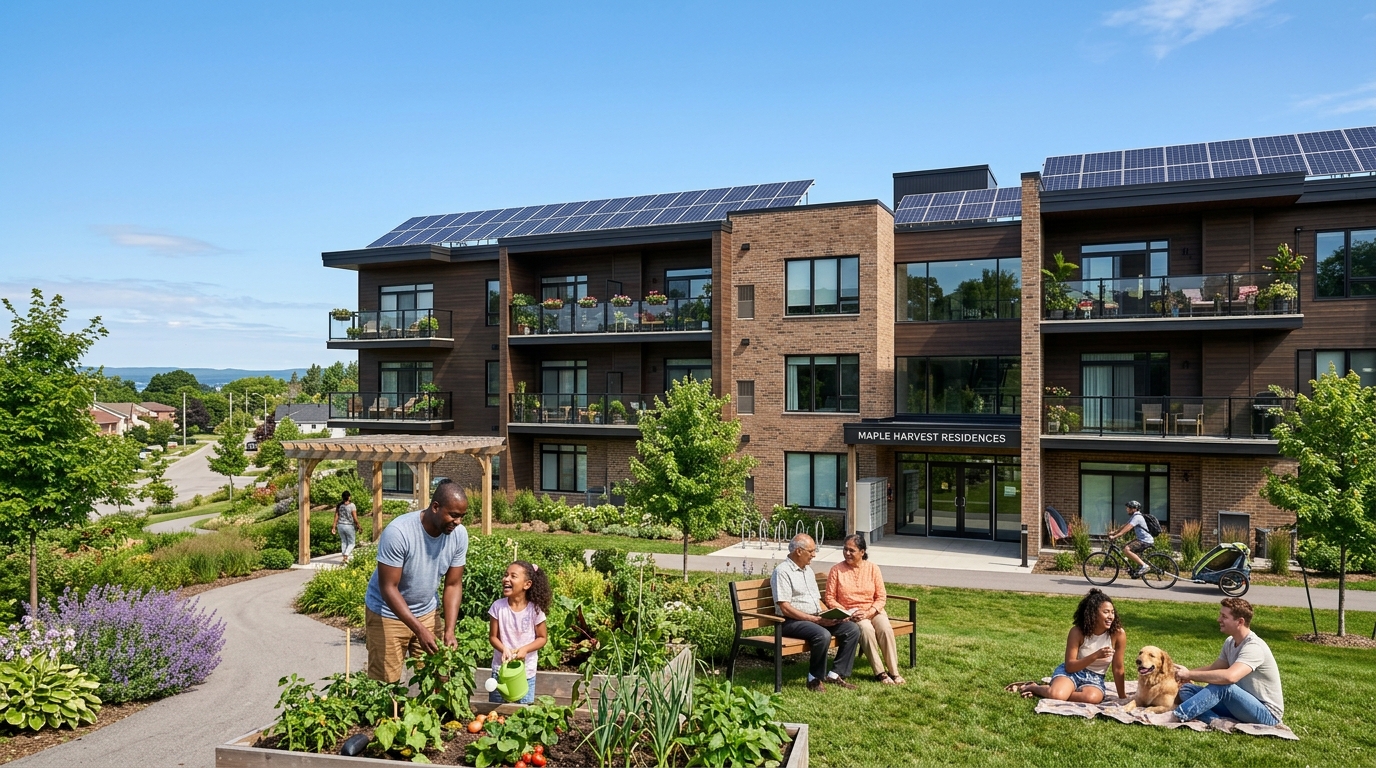
The Canadian real estate market, particularly its multifamily and affordable housing segments, stands as a bedrock of stability and long-term value. At Yield the North, our conviction is unwavering: this sector, fueled by relentless demand and supported by robust regulatory frameworks, represents the most secure investment thesis in the country. Now, as discussions around Environmental, Social, and Governance (ESG) principles evolve, private credit is emerging as not just a complementary financing tool, but as the essential, agile capital source for building a truly sustainable housing future in Ontario.
While public discourse often grapples with market corrections or transient rental volatility, our focus remains on the foundational signals: structural demand, protected revenue floors, and unparalleled government-backed financing. The intersection of these elements, combined with a pragmatic approach to sustainability, reveals a powerful opportunity for private credit investors.
The Unyielding Demand and the Supply Chasm
Canada's housing demand is not a discretionary luxury, but a demographic imperative. Anchored by ambitious immigration targets and consistent household formation, the need for housing continues to outpace supply. The federal government's plan to welcome 500,000 immigrants annually by 2025 ensures a persistent influx of new residents, each requiring a place to call home. This demographic reality creates a structural demand floor that is unmatched in other asset classes.
Despite this undeniable need, the supply side continues to falter. The Canada Mortgage and Housing Corporation (CMHC) recently forecasted a decline in housing starts through 2028, a sobering outlook that underscores the deepening supply gap. iPolitics reported on CMHC's projection that housing starts are expected to decline, a trend that exacerbates an already critical shortage. This isn't a temporary blip, but a long-term structural issue that guarantees sustained demand for existing and new housing stock, particularly in the rental market.
Ontario, as Canada's most populous province and a primary destination for immigrants, feels this pressure acutely. Its secondary markets, often overlooked by larger institutional players, are experiencing significant population growth without corresponding housing development. This creates a compelling environment for investors who understand the enduring nature of this supply demand imbalance. Asking rent volatility, as observed in some markets like Toronto or even London, Ontario, is often noise. The signal is the fundamental gap between people needing homes and the availability of those homes, which consistently drives in-place revenue stability for well-located, well-managed multifamily assets.
ESG's Evolution: From Broad Mandates to Targeted Impact
The conversation around ESG in Canadian real estate is maturing. While 76% of institutional investors consider ESG factors, a recent survey highlighted by Benefits Canada.com noted that overall support for ESG might be dwindling or shifting. This doesn't mean ESG is disappearing, but rather that its application is becoming more nuanced and focused. The initial broad-stroke mandates are giving way to a demand for concrete, measurable impact and direct alignment with financial returns.
This evolution presents a unique opportunity for private credit. Unlike large, often bureaucratic institutional funds, private credit can be agile and highly targeted. It can directly finance projects that deliver tangible social and environmental benefits, such as purpose-built rental housing with energy-efficient designs or affordable housing initiatives that directly address social equity. This direct line of sight from capital deployment to measurable impact is a significant advantage for private lenders and investors seeking genuine sustainable returns.
Sustainable Biz Canada recently emphasized the need to double down on ESG in Canadian real estate, not dial back. This sentiment aligns perfectly with the private credit thesis. By focusing on the 'S' and 'E' in ESG within the multifamily and affordable housing sectors, private credit can fund projects that inherently provide social benefit through housing provision and environmental benefit through modern, efficient construction. This targeted approach bypasses the potential 'greenwashing' critique sometimes leveled at broader ESG strategies, delivering clear value both to the community and to investors.
Private Credit: The Agile Capital for Sustainable Multifamily
Private credit is uniquely positioned to bridge the gap between evolving ESG expectations and the urgent need for sustainable housing. It offers flexibility, speed, and a bespoke approach that traditional lenders may struggle to match. For developers committed to building energy-efficient, resilient, and community-centric multifamily properties, private credit provides a vital capital source.
Consider the direct impact: private credit can finance the acquisition of land for a new affordable housing complex designed to Passive House standards, or provide construction financing for a mid-rise rental building utilizing low-carbon materials. These are not abstract ESG goals, but concrete, shovel-ready projects that require patient, strategic capital. Private lenders can structure terms that incentivize sustainable building practices, such as tying interest rates to specific environmental certifications or energy performance targets.
Furthermore, private credit can step in where traditional debt markets are cautious due to perceived market volatility or the longer development cycles inherent in sustainable projects. By offering tailored financing solutions, private credit providers become true partners in bringing these essential projects to fruition. This aligns perfectly with the Yield the North ethos: focusing on in-place revenue, structural demand, and the long-term fundamentals of the asset class, rather than short-term market noise.
CMHC MLI Select: De-risking and Amplifying Impact
The most compelling argument for private credit's role in sustainable multifamily, particularly affordable housing, is its synergy with CMHC MLI Select financing. This government-backed program is arguably the most efficient capital deployment tool in the entire commercial real estate stack. Offering up to 95% loan to value (LTV) and 50-year amortizations for purpose-built rental and affordable housing, MLI Select dramatically de-risks projects and enhances investor returns.
No other asset class in Canada offers comparable government-backed financing. This creates a powerful capital stack opportunity where private credit can act as the crucial bridge or mezzanine financing, complementing the low-cost, long-term CMHC debt. For instance, private credit can fund the initial stages of a project, covering land acquisition, planning, and pre-development costs, until the project qualifies for CMHC MLI Select. This allows developers to move forward with confidence, knowing a robust, government-supported take-out financing option exists.
Moreover, the MLI Select program itself incorporates an affordability and sustainability component, rewarding projects that achieve higher scores in these areas with more favorable financing terms. This inherent alignment means that private credit deployed into MLI Select eligible projects is directly contributing to both social and environmental goals, while benefiting from the superior economics of the program. It's a prime example of how financial stability and sustainable impact are not mutually exclusive, but rather mutually reinforcing in the Canadian multifamily context.
The Ontario Opportunity: Secondary Markets and Long-Term Value
Ontario's secondary markets continue to present a fertile ground for this combined private credit and sustainable housing strategy. Cities like London, Hamilton, Kitchener-Waterloo, and even smaller centres like Chatham-Kent, despite some recent softening in asking rents, demonstrate robust long-term potential. These markets are experiencing significant population growth, driven by both interprovincial migration and international immigration, yet they face the same, if not more pronounced, supply constraints than the Greater Toronto Area.
While Rentals.ca data might show some provincial averages for rent decline, a deeper dive reveals resilience in many secondary markets. Hamilton, for example, has seen rental rises, demonstrating localized strength. The key is to look beyond aggregated noise and focus on the fundamental drivers. The structural supply gap, coupled with CMHC's forecast of declining housing starts through 2028, means that any well-located, professionally managed multifamily asset in these growth markets will retain its value and tenant demand.
Private credit investors focusing on these areas can capitalize on the lower acquisition costs compared to primary markets, while still benefiting from strong rental demand and the potential for long-term appreciation. By funding sustainable, affordable housing projects in these communities, private credit isn't just generating returns, it's actively contributing to the economic and social well-being of Ontario. This is investing with purpose, where the 'S' and 'E' of ESG are naturally embedded in the core business model, not merely tacked on as an afterthought.
The Enduring Signal
The Canadian real estate market, particularly its multifamily and affordable housing sectors, remains a fundamentally sound investment. The confluence of structural demand driven by immigration and household formation, a persistent supply gap, and the unparalleled support of CMHC MLI Select financing creates an investment environment unlike any other. Private credit, with its agility, targeted approach, and ability to complement government programs, is the optimal capital provider for sustainable development within this robust segment.
As the broader ESG conversation matures, private credit offers a direct, impactful pathway to funding projects that are both financially sound and socially responsible. We believe that focusing on these core signals, rather than being swayed by transient market fluctuations, is the true path to durable wealth creation in Canadian real estate. Private capital's role in building Ontario's sustainable housing future is not just important, it is essential.